Why Time Disappears Completely With ADHD
ADHD time blindness makes every deadline feel equally urgent (or invisible). Here's why it happens and what actually helps when your brain can't read the clock.


ADHD Time Blindness: Why Your Brain Lies About Time (And What Actually Helps)
Listen to this post
Hit play and do your thing. Ara reads it to you.
You know that thing where someone says "this'll take five minutes" and your brain just.. believes them? Even though literally nothing in your entire life has ever taken five minutes?
Or when you're hyper-focused on something and suddenly it's dark outside and you haven't eaten and wait, wasn't I supposed to be somewhere three hours ago?
That's ADHD time blindness. And it's not about being bad at time management or needing a better planner.
It's your brain genuinely not perceiving time the way neurotypical brains do.

The Thing Nobody Tells You About ADHD Time Blindness
Most people experience time like a running ticker in the background. They just.. know when 20 minutes has passed. They can feel it.
With ADHD time blindness, that internal clock is broken. Or missing entirely. Or working on vibes only.
Research from CHADD shows that people with ADHD struggle to estimate time duration, perceive how much time has passed, and judge how long tasks will take. It's a core executive function issue, not a personality flaw.
You're not lazy. Your brain's time-tracking software literally runs differently.
And here's the part that makes it extra fun: time moves inconsistently for us. Five minutes waiting for a text back feels like 40 years. Three hours doing something interesting feels like twelve seconds.
Time doesn't flow. It teleports.
The Two Time Zones Your ADHD Brain Recognizes
Someone on our Discord server described it perfectly: "My brain only knows two times. Now and Not Now."
Now: Anything requiring immediate attention. The thing currently on fire.
Not Now: Everything else. Doesn't matter if it's in 20 minutes or 20 days. It lives in the same vague future blur.
This is why you can forget about a dentist appointment you made six weeks ago, but also forget about dinner plans you made this morning. Both lived in Not Now, which might as well be another dimension.
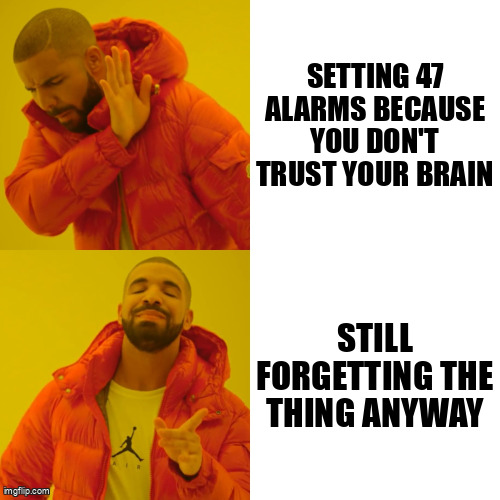
According to Understood.org, this isn't about caring less. It's about the ADHD brain struggling with prospective memory (remembering to remember) and time perception. The future doesn't feel real until it smacks us in the face.
Usually five minutes after we were supposed to be there.
Why "Just Check The Clock More" Doesn't Work
People love suggesting this one. "Have you tried just.. looking at the time?"
Sure, Jan. Let me just check this clock that my brain can't translate into meaningful information.
I can look at a clock that says 2:47pm and think "okay, I have a 4pm meeting, that's plenty of time" and then look up again and it's 4:32pm and I'm still in my pajamas.
The problem isn't seeing the numbers. It's that those numbers don't connect to the actual passage of time in any useful way.
It's like reading a map in a language you don't speak. The information is technically there. Your brain just can't process what it means.
What Actually Helps (From Someone Living It)
I'm not going to tell you these strategies will "fix" your ADHD time blindness. They won't. But they do help make it less likely that you'll completely accidentally destroy your own schedule.
External time markers everywhere:
Not just clocks. Timers, alarms, visual timers that show time disappearing. I have a Time Timer on my desk that shows a red disk shrinking as time passes. Watching time physically vanish helps my brain understand it's actually moving.
The "add 50%" rule:
However long you think something will take, add 50%. Your brain is lying to you about task duration. It always has been. Stop trusting it.
If you think you need 20 minutes to get ready, block out 30. If you think a task is a quick 10-minute thing, give yourself 15.
Your brain will fight this. Do it anyway.
Backwards calendar planning:
Start from the deadline and work backwards, blocking every single step. Not because you'll follow it perfectly, but because seeing all the steps written out stops your brain from thinking "the presentation is Friday" means you can start Thursday night.
ADDitude Magazine calls this "making the invisible visible," and honestly that's exactly what it is. Your brain can't see future time, so you have to draw it a map.

Body doubling, but make it structured:
Having someone else present (in person or virtually) creates external time structure your brain can actually track. We do co-working sessions in The ADHD Nest Discord community specifically for this reason.
When you're alone, time is a lawless void. When someone else is there, their presence creates time anchors your brain can grab onto.
I'll literally hop into our Discord's body doubling channel and say "focusing for 25 minutes" just so my brain recognizes that 25 minutes is a real amount of time that will actually pass.
The alarm cascade method:
One alarm doesn't work because your brain dismisses it. But a series of alarms creates urgency momentum.
For a 3pm appointment, I set alarms at: - 2:00pm (first warning) - 2:30pm (start getting ready) - 2:45pm (you should be leaving) - 2:50pm (LEAVE NOW)
Is it excessive? Yes. Does it work better than anything else I've tried? Also yes.
The Emotional Weight Nobody Talks About
Here's the thing they don't put in the ADHD articles: time blindness doesn't just make you late.
It makes you feel like you're constantly letting people down. Like you're fundamentally unreliable. Like you can't be trusted with basic adult responsibilities.
You're not trying to be disrespectful when you're late. You're not blowing people off when you forget plans. Your brain genuinely didn't register that time was passing or that the thing was today.
But people don't see that. They see the behavior. And the shame builds up until you're avoiding making plans at all because you're terrified of disappointing people again.
If that's you right now, I need you to hear this: your worth isn't measured in punctuality.
Yes, we need to develop strategies. Yes, being chronically late affects relationships. But you're not a bad person because your brain processes time differently.
You're a person with ADHD trying to exist in a world built for neurotypical time perception.
That's hard. And you're allowed to acknowledge that it's hard.

The "Good Enough" Approach
Look, I'm never going to have perfect time management. My brain will always be a little bit feral about schedules.
But I can be good enough.
Good enough means I show up mostly on time to the things that matter. Good enough means I sometimes remember appointments without a full alarm symphony. Good enough means I'm learning to build in buffer time instead of optimistically assuming I'll suddenly develop neurotypical time awareness.
Good enough is actually pretty damn good when you're working with ADHD time blindness.
Some strategies that help me get to "good enough":
I keep a running list of how long things actually take me. Showering? 25 minutes, not the 10 I always think. Grocery shopping? 90 minutes minimum, even if I "just need a few things." Writing these down stops my brain from reinventing optimistic math every time.
I also stopped scheduling back-to-back anything. If something ends at 2pm, my next thing can't start until 3pm. That buffer time catches all the ways my brain lies about transitions.
And if you're looking for focus tools that actually work with ADHD brains, I keep a whole playlist of study and work music on my YouTube channel. Sometimes the right background noise is the difference between time disappearing and time feeling manageable.
You're Not Broken, You're Different
Your brain isn't failing at time. It's just running different time-processing software.
The neurotypical world is built around internal time awareness that you don't have. That's not your fault. But it is your reality to navigate.
So we build external systems. We set embarrassing numbers of alarms. We ask people to text us reminders. We join body doubling sessions with strangers on the internet who get it.
We do what we need to do to function in a world that doesn't quite fit our brains.
And some days we still show up late, forget the thing, or lose three hours to hyperfocus and have no idea where they went.
That's ADHD time blindness. That's just how it is sometimes.
But you're here, reading this, looking for strategies. That counts for something.
Your Turn 🪴
What's your relationship with time like? Are you team "47 alarms for everything" or team "time is a social construct and I've made peace with chaos"? Drop a comment below or come tell us in The ADHD Nest Discord. We're probably all there right now, having completely lost track of what day it is.